
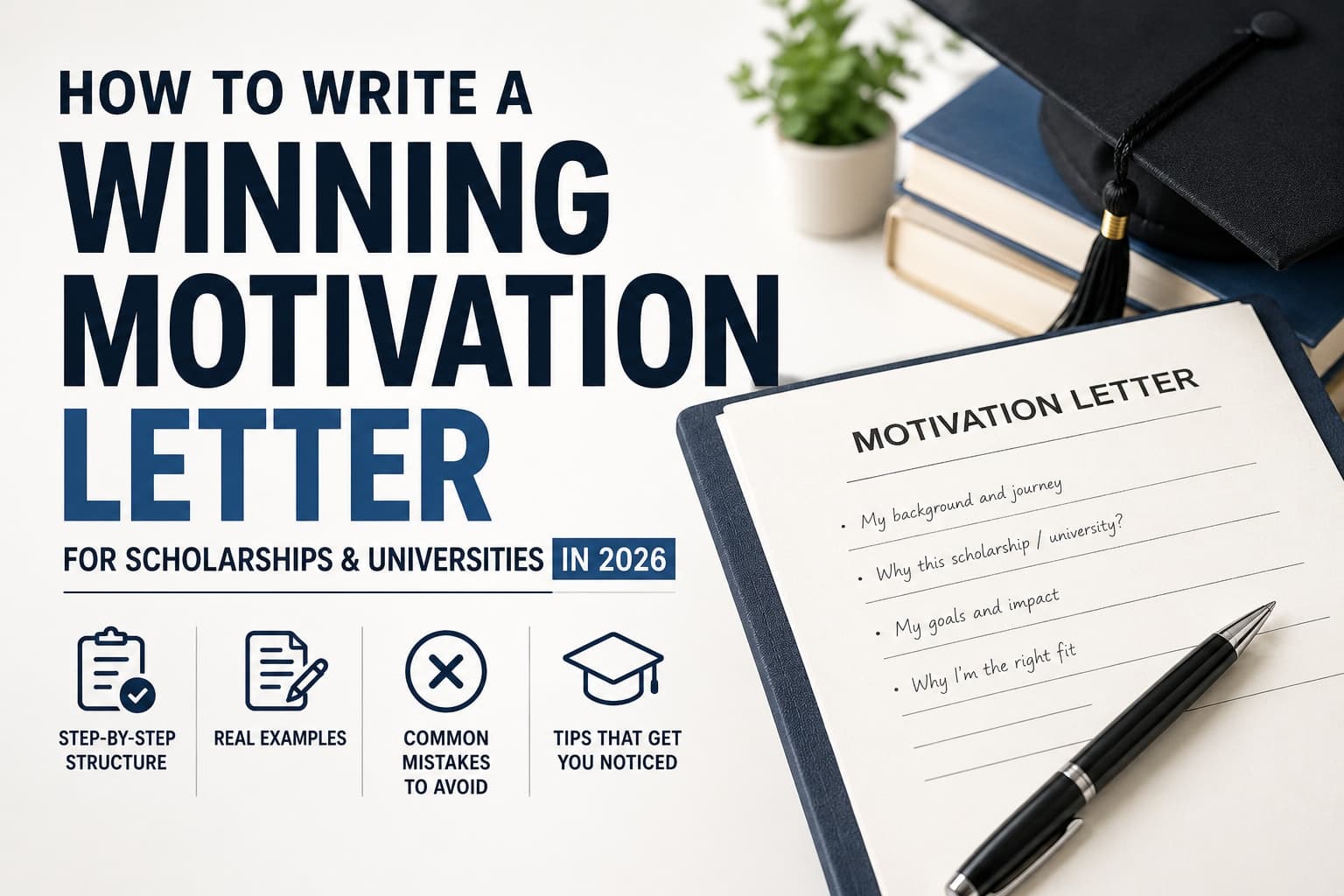
How to Write an Effective Motivation Letter (2026 Guide)
Learn how to write a winning motivation letter for scholarships and universities in 2026, with a step-by-step structure, real examples, and common mistakes to avoid.
How to Write an Effective Motivation Letter in 2026 (Complete Guide)
A motivation letter is often the single most decisive document in any scholarship, university, or PhD application. Your transcripts show what you've done. Your test scores show how you compare on paper. But your motivation letter is the only place where an admissions committee or professor actually hears your voice: why you want this specific opportunity, why you're ready for it, and what you'll do with it.
Most applicants struggle here. Not because they lack achievements, but because they don't know how to translate those achievements into a compelling, well-structured narrative. This guide breaks down exactly how to write a motivation letter that stands out in 2026, with practical tips, a step-by-step structure, and the mistakes that quietly disqualify strong candidates every year.
You may also want to read our companion guide: How to Make an Effective Resume (CV) in 2026.
What Is a Motivation Letter (and Why It Still Matters in 2026)
A motivation letter, sometimes called a statement of purpose or letter of intent, is a short, personal essay explaining why you are applying to a specific program, university, or scholarship, and why you are a strong fit for it. Unlike your CV, which lists facts, a motivation letter interprets those facts. It connects your background to your goals and to the opportunity in front of you.
With AI writing tools now widely available, admissions committees in 2026 are more alert than ever to generic, AI-sounding, or templated letters. This makes genuine, specific, well-researched writing more valuable, not less. A letter that reads like it could have been sent to any university, for any program, is now easier to spot and easier to reject.
Step 1: Start Early and Give Yourself Time to Think
Give yourself real time before your deadline, ideally several weeks, not a few days. A motivation letter is rarely finished in one sitting. The first draft is almost never the strongest version. When you step away and return a day or two later, you'll naturally spot weak sentences, vague claims, and better ways to phrase your ideas.
This isn't about talent. It's about revision. If you're a bachelor's, master's, or PhD applicant, you already have the ability to write strong academic content. What most letters need isn't more talent; it's more drafts.
Practical tip: Write your first draft, then leave it untouched for at least 24 hours before editing. Small distance dramatically improves your ability to catch weak spots.
Step 2: Never Repeat Your CV
This is one of the most common mistakes applicants make, and one of the easiest to fix. Your motivation letter should not restate your CV in paragraph form. If a reader can already see your GPA, your internships, and your publications on your CV, listing them again in your letter wastes valuable space and signals that you can't explain yourself beyond a list of facts.
Instead, use your motivation letter to explain the why and how behind your achievements. Don't just say you worked on a research project. Explain what problem you were solving, what you learned about your own thinking, and how it shapes what you want to do next. Admissions committees and professors aren't looking for a second copy of your resume; they're looking for evidence that you can think and communicate clearly about your own experience.
Step 3: Answer These Questions Before You Write a Single Sentence
Before drafting your letter, take a blank page and honestly answer the following:
- Have you actually read the professor's or department's recent research, publications, or program focus areas?
- Can you draw a clear, specific line between your own background and their work or program?
- Why this exact country, university, or department, and not simply "a scholarship abroad"?
- Out of hundreds or thousands of applicants, why should they choose you specifically?
- Are you prepared to leave your comfort zone for this opportunity? What does that actually look like in practice?
- What does the university, professor, or program gain by admitting you?
- What will you concretely do with this opportunity once you're admitted?
If you can answer all seven honestly and specifically, you already have the raw material for a strong letter. Most weak letters fail not because of bad grammar, but because the applicant never did this thinking beforehand.
Step 4: Fix Your Grammar, Spelling, and Prepositions Every Time
Small language errors are still one of the fastest ways to get disqualified in 2026, even with spell-checkers and AI grammar tools everywhere. Reviewers read hundreds of letters; sloppy mistakes signal carelessness regardless of how strong your ideas are.
Proofread multiple times, on different days, and ideally out loud. Reading aloud makes awkward phrasing and missing words much easier to catch. Ask a friend, mentor, or teacher to review it as well, since a second pair of eyes will always catch something you missed.
One important caution for 2026 specifically: if you use AI tools to check grammar, use them only to polish, not to write your letter for you. Over-relying on AI to generate content is easy for experienced reviewers to detect, and it removes the very thing that made your letter valuable in the first place, your own voice.
A related note on vocabulary: don't try to impress readers with complicated words pulled from a thesaurus. Write in clear, natural language you would actually use. Overly polished vocabulary that doesn't match the rest of your writing style makes readers suspicious that the content wasn't genuinely yours.
Step 5: Write With Flow, Not Just Facts
A good motivation letter reads like a connected argument, not a list of disconnected statements. Use transition words such as moreover, therefore, hence, however, and as a result to guide the reader logically from one idea to the next. This keeps your reader engaged and makes your reasoning easier to follow.
Structure matters as much as content. A clear, effective motivation letter typically follows this shape:
- Opening hook: a specific moment, question, or experience that led you toward this field (avoid generic openings like "Since I was a child, I have always been passionate about...").
- Academic and professional background: briefly, and only the parts directly relevant to this specific program.
- Why this program, university, or professor: specific, researched, and personal, not copy-pasted between applications.
- What you bring and what you plan to do with it: your unique contribution and your post-program goals.
- A confident, forward-looking closing: restate your fit without repeating earlier sentences word-for-word.
Always finish with a final proofreading pass, and where possible, have a senior student, mentor, or teacher review your letter before submission.
Frequently Asked Questions
How long should a motivation letter be? Most programs expect 500 to 1,000 words, roughly one page. Always check the specific program's guidelines first, since some scholarships set strict word or character limits.
Is it okay to use AI tools like ChatGPT or Claude to help write my letter? Use AI to brainstorm ideas, check grammar, or get feedback on structure, but the final content, reasoning, and personal details should be genuinely yours. Admissions reviewers in 2026 are increasingly trained to spot generic AI-generated writing.
Should I use the same motivation letter for multiple applications? No. Reusing an identical letter across different universities or scholarships is one of the fastest ways to get rejected, since reviewers can easily tell when a letter wasn't written specifically for their program.
What's the biggest mistake applicants make? Repeating the CV instead of interpreting it, and failing to research the specific program or professor before writing.
Should I mention weaknesses or gaps in my academic record? Only if relevant, and only briefly. Frame them around what you learned or how you grew, rather than dwelling on them.
Final Thoughts
Writing a strong motivation letter isn't about creative genius. It's about genuine self-reflection, real research into your target program, and disciplined editing. Give yourself time, avoid repeating your CV, answer the hard questions honestly before you write, polish your grammar relentlessly, and let your writing flow naturally from one idea to the next.
Do this consistently, and you'll find that writing a comprehensive, compelling motivation letter isn't the intimidating task it first appears to be. It's simply a process, and one you can repeat with confidence for every application you submit.
About the Author
Nadia Bridman writes about scholarships, financial aid, and the application process for students navigating the search for funding. Her pieces focus on practical, step-by-step strategies drawn from real application experiences, aimed at helping students turn a stack of "no's" into a "yes." If you want, I can write a couple variations — one more formal/credential-driven for a bio page, one shorter for byline snippets under each post title. Just let me know the tone you're going for.